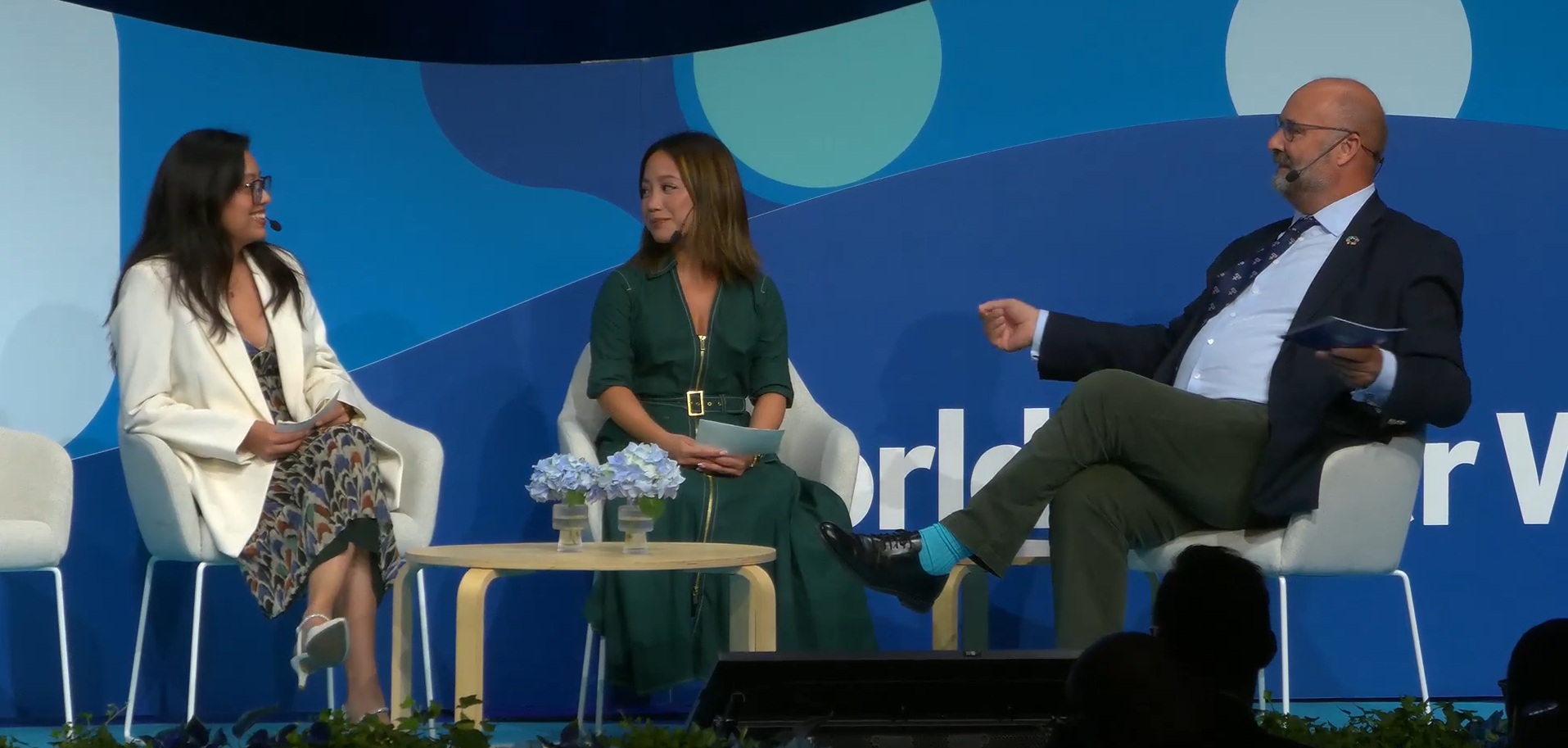
At World Water Week 2025, the session “Gender Equality and WASH – Mutually Reinforcing Domains of Change” highlighted a vital message: achieving universal water, sanitation and hygiene (WASH) access and advancing gender equality are deeply interconnected. Convened by Agenda for Change, WaterAid, and World Vision, the discussion showcased how gender-responsive WASH programming can drive broader social inclusion and women’s empowerment while making systems more effective and sustainable.
The urgency is clear. The 2024 Global Gender Gap Report warns that, at the current rate, closing the gender gap will take 134 years. One in ten women lives in extreme poverty, and nearly one in four countries is witnessing setbacks in women’s rights. In this context, WASH is more than a development goal; it is a lever for gender justice, influencing health, education, livelihoods, and safety for women and girls.
Speakers stressed that gender equality is central to WASH system strengthening, not a secondary concern. Martina Nee of WaterAid framed the discussion around three priorities: thinking in systems, thinking beyond access, and thinking accountability. Strengthening governance, financing and service delivery is essential to embed gender considerations across all levels of planning and implementation.
Parvin Ngala of World Vision International presented the Beyond Access programme in Kenya, Zimbabwe, Guatemala and Honduras, which combines mindset change, economic empowerment and inclusive community engagement. This approach moves beyond infrastructure, addressing social norms that limit women’s roles.
Jane Wilbur of the London School of Hygiene and Tropical Medicine shared the Vay Vanuatu campaign, which supported menstrual health for women and girls with intellectual disabilities, showing how inclusion dismantles stigma and promotes dignity. Similarly, Fauzia Aliu of WaterAid discussed the Securing Water Resources initiative in Ghana and Burkina Faso, where women were trained to monitor groundwater and rainfall—empowering them to contribute to climate-resilient water governance.
These insights strongly align with experiences across South Asia, where inclusive WASH approaches are essential for climate resilience and social equity. The South Asia Young Women in Water (SAYWiW) initiative, for instance, connects young professionals from across the region to share knowledge and advance gender-responsive solutions. Through the South Asia Water Dialogues, SAYWiW has spotlighted local innovations addressing climate-driven water scarcity and inequality—demonstrating how women’s leadership strengthens WASH outcomes and drives wider social impact.
SAYWiW’s collaborations with global institutions such as the World Bank (ECH2O and Equal Aqua communities), International Water Association (IWA), and She Changes Climate further reinforce the importance of connecting South Asian expertise with international policy discussions. These partnerships create opportunities for youth leaders to contribute to systemic approaches that integrate gender, climate resilience and water governance.
The session also underscored the need for political will and sustained investment to safeguard hard-won progress. This resonates in South Asia, where governance gaps and financing limitations often constrain service delivery despite strong community-led action. By including youth and women in decision-making, particularly from climate-vulnerable and water-insecure contexts, policies and programmes become more adaptive, equitable and sustainable.
Four key messages framed the way forward. First, gender equality and WASH are mutually reinforcing; advancing one accelerates the other, creating benefits across education, health and livelihoods. Second, systems change is vital—short-term projects alone cannot deliver transformative impact. Third, inclusion must go beyond majority reach to ensure that the most marginalized, including people with disabilities and indigenous groups, are fully represented. Finally, political will and investment are crucial to protect gains and scale innovation.
For South Asia, these takeaways have particular relevance. Women and young professionals across the region are already leading initiatives that link water security to gender justice, whether through menstrual health campaigns, grassroots water governance, or climate-adaptive infrastructure. What is needed now is recognition of their expertise at global platforms and integration of their perspectives into mainstream policy frameworks.
World Water Week 2025 reaffirmed that the path to gender equality and universal WASH access depends on collective action, shared learning, and the meaningful inclusion of diverse voices. Initiatives like SAYWiW demonstrate how regional knowledge and youth leadership can enrich global strategies—bridging principles with practice and turning commitments into lasting change.